Cross-country mountain biking has always been one of the sport's biggest drivers of innovation. From…
Carbon fibre is one of the most revolutionary materials in modern technology, admired for its strength, lightness, and versatility. It is used in a variety of industries, from aerospace and automotive to cycling and sports equipment. For cyclists, carbon fibre wheels, frames, and components offer incredible performance, combining lightweight durability with strength.
But how is carbon fibre actually made? In this blog post, we’ll take a deep dive into the process of carbon fibre production, from the raw materials to the final product. Understanding this process will give you a better appreciation for how your carbon bike wheels or other carbon-based equipment are created.
What Is Carbon Fibre?
Before we get into the manufacturing process, it’s important to understand what carbon fibre is. Carbon fibre is made from carbon atoms bonded together in a long, crystalline structure. The resulting material is incredibly strong yet lightweightand rigid. It’s used in applications where high strength-to-weight ratios are crucial.
In its most common form, carbon fibre is a filament that is woven into fabrics, and it can then be combined with resins to create rigid composites. The process of making carbon fibre itself involves several critical steps that transform raw materials into a versatile, high-performance material.
Step 1: Precursor Material
The first step in making carbon fibre begins with a material known as a precursor. The most commonly used precursor for carbon fibre is polyacrylonitrile (PAN), which is a type of plastic polymer. PAN is the primary starting point because it can be easily converted into carbon fibre through heat and chemical processes.
Other Precursor Materials
While PAN is the most widely used, pitch (a byproduct of petroleum refining) and rayon are also used as precursor materials, although less commonly. Each precursor will have a slightly different structure and result in carbon fibres with varying properties such as strength, flexibility, and modulus.
Step 2: Spinning the Precursor
Once the precursor material is chosen, the next step is to spin it into long filaments. In this process, the precursor is dissolved in a solvent and then passed through a spinning device, where it is forced through tiny holes to create long, thin fibres. These filaments are wound into large spools and are now ready for the next step.
This process is similar to making synthetic yarn for textiles. The goal is to create long, continuous strands that will later be woven or bundled together.
Step 3: Stabilization
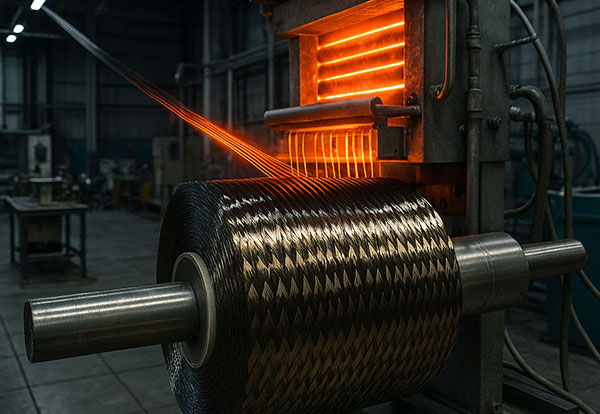
Now that the filaments are spun, they need to undergo a process called stabilization. In this step, the precursor fibres are heated in an oxygen-rich environment at temperatures around 200–300°C. This process alters the molecular structure of the precursor material, making it more stable and preventing it from melting in the subsequent carbonization stage.
During stabilization, the fibres undergo oxidation, which causes chemical changes that prepare them for the extreme heat required later in the process. Stabilization typically takes several hours and is a critical step in ensuring that the fibres retain their strength and structure during the next phase.
Step 4: Carbonization
Carbonization is the most important and transformative step in the production of carbon fibre. During this phase, the stabilized fibres are subjected to high temperatures, typically between 1,000 and 3,000°C (1832–5432°F), in an environment where there is very little or no oxygen. This process effectively “burns off” everything that is not carbon, including hydrogen, nitrogen, and oxygen.
The carbon atoms left behind in the fibres are then bonded together in a graphite-like structure, creating the material known as carbon fibre.
Key Points of Carbonization
- The high temperature causes the molecular bonds in the precursor to break, releasing gases.
- The result is a fiber that is mostly made of carbon, usually around 90-95% carbon by weight.
- The carbon fibre produced during this process is still very brittle and needs further treatment to become usable in final products.
Step 5: Surface Treatment
After carbonization, the fibres are still relatively smooth, but to bond effectively with resins, they need a textured surface. This is where surface treatment comes in. The carbon fibres are subjected to a process where their outer surfaces are treated to increase their adhesion properties. This is typically achieved by oxidizing the surface using a mild acidic solution or electrical discharge.
This treatment creates microscopic roughness on the surface of the fibre, allowing resin to adhere more effectively during the subsequent stages of manufacture. This is especially important in the production of carbon fibre composites, where the resin bonds with the fibres to form the final material.
Step 6: Spooling or Weaving
Once the carbon fibres are treated, they are wound into spools or woven into fabrics. This is the stage where the material is formed into a shape that will be used for final products. There are several types of carbon fibre products at this point:
- Continuous Filament: The long, continuous filaments are wound into spools for use in filament winding or other processes.
- Woven Fabrics: Carbon fibres are woven into fabrics in a specific pattern (like plain weave, twill weave, or satin weave). These fabrics are used in processes like lay-up, where the fabric is combined with resin to form a rigid composite.
- Tow: The individual fibres are grouped together into bundles called tows. These are also used in weaving or lay-up processes.
The weaving process is particularly important in the manufacture of products such as carbon fibre bike frames and wheels, where the orientation and weave of the fibre affect the overall performance and strength of the final product.
Step 7: Impregnation with Resin (Composite Manufacturing)
In the final step of creating carbon fibre products, the woven fabrics or continuous filaments are combined with a resin matrix to form carbon fibre reinforced polymer (CFRP). This is the composite material used in bicycle frames, automotive parts, aerospace components, and more.
The carbon fibre fabric or tow is impregnated with epoxy or polyester resin. The resin is used to bind the fibres together and give the final product its strength, shape, and stiffness. Once impregnated, the material is placed in a mold or on a preform and then subjected to heat and pressure to cure the resin. This process is typically done in a autoclave, a high-pressure oven, or using vacuum bagging techniques.
After curing, the final product is removed from the mold and trimmed to size. This could be carbon fibre wheels, frames, or any other product made from carbon fibre.
Final Product: Carbon Fibre Components
Once the carbon fibre has been processed and cured, it can be used in a wide variety of applications, from aerospace to cycling. For example, carbon fibre bike wheels are made by laying the impregnated carbon fibre sheets in specific layers, depending on the intended application. These layers are aligned in the best direction to give the final product the right strength, flexibility, and lightness.
The finished component is often sanded, painted, or polished to give it a sleek, finished look. Final quality checks are performed to ensure the product meets the required specifications for performance and safety.
The Importance of Carbon Fibre in Modern Manufacturing
Carbon fibre is a game-changer in the world of engineering and design. Its lightweight nature and incredible strength make it ideal for products that require both durability and performance. Whether it’s in a high-performance bike wheel, a racing car, or an aerospace vehicle, carbon fibre continues to play a pivotal role in pushing the limits of what’s possible in design and performance.
Understanding how carbon fibre is made gives us a greater appreciation for its qualities and its versatility as a material. It’s a process that combines chemistry, engineering, and innovation to create a product that’s not just strong but also lightweight, flexible, and highly adaptable for a range of uses.
At VeloElite Wheels, we use the latest carbon fibre technology to bring you wheels that are built for speed, stability, and performance. Our carbon fibre wheels offer all the benefits of this cutting-edge material, and we’re proud to be part of an industry that’s making cycling faster, safer, and more exciting than ever before.
Related Posts